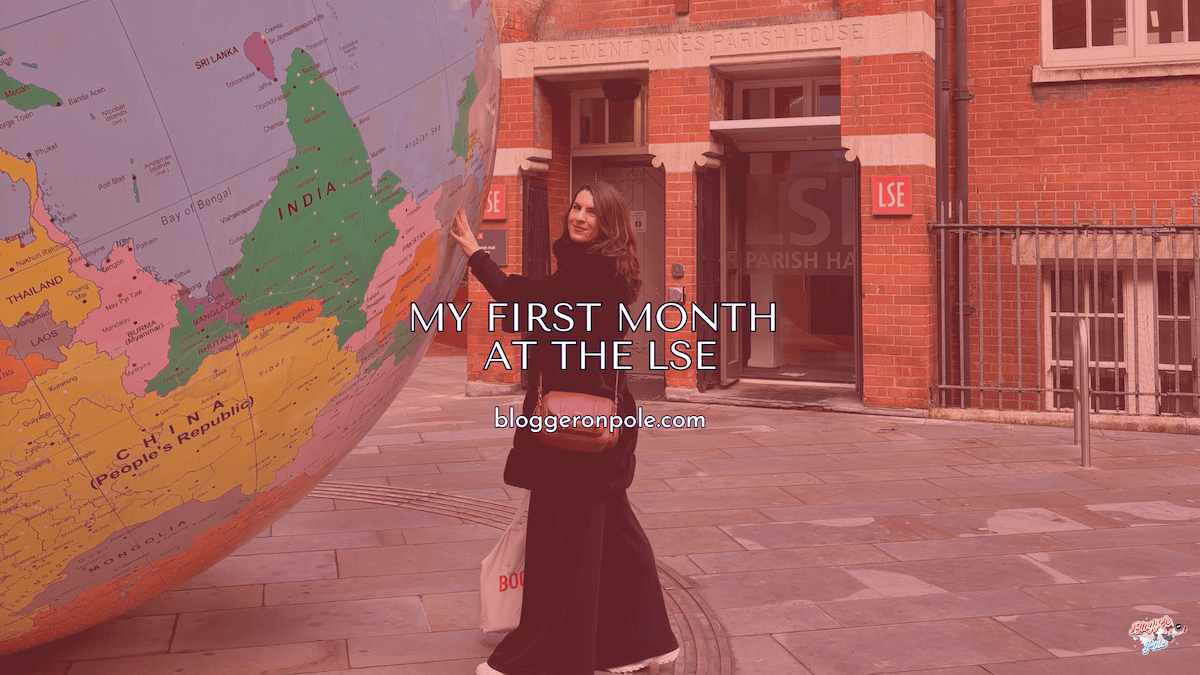
My first month in my new job as an LSE Fellow in Interdisciplinary Social Science has officially drawn to a close. Teaching and researching at the London School of Economics and Political Science has been a wonderful surprise, a big adjustment and a really inspiring learning curve, so it’s only fair my new job got its blog update.

Getting my LSE job
As some of you may remember from my constant whining last year, the academic job market is hell and I’ve not been shy about it. My colleague Zoe and I bonded over it, since we were at similar stages in our career. She had started in the role I currently cover at the LSE in September, and when a new position opened up she recommended that other early-career scholars and I should apply. Zoe spoke highly of the job, the team, the workload, so I applied and forgot about it in between all the panic and the many applications I submitted.
You can imagine my surprise when I got invited for an interview. These roles receive hundreds of applications, and I previously had always been rejected when applying for LSE fellow positions. Even though I had a few more interviews lined up, I wanted to make sure I had a good shot at it. I was somehow really chill about it, mainly because I didn’t know what to expect or if the job was going to be right for me, so I didn’t have the time to get attached to the idea of getting it.
When I arrived, the team was fun and welcoming – miles away from some interviews I’ve been to, where there was a feeling of deep freeze in interview rooms. The interview felt like a friendly chat, and the more I spoke to them, the more I learnt about the job, the more I wanted to work there.
My interview was on a Friday, and I forced myself to avoid checking my emails too often to make sure destiny wasn’t aided by my anxiety in getting me yet another rejection I didn’t wanna deal with. They get harder after an interview, somehow.
The signs started delivering the following Tuesday. My former boss texted me that she’d got a reference request from the LSE when I was coming back from my partner’s house after his birthday. Then I opened my email, and found that HR asked me to provide context on why I’d selected “Yes” in response to the question: “Do you appear on a barred list prohibiting you from working with children or vulnerable adults?”
I obviously do not appear on that list, but the level of brain fog and anxiety I must have had when applying for multiple jobs last year meant I accidentally ticked that box. Luckily, the misunderstanding was cleared straight away and I got a call offering me the position shortly after. We agreed on January 7th as my start date, even earlier than I’d budgeted and planned for my career break.
It was a perfect early birthday and Christmas present.
I spent the rest of December celebrating my birthday and sleeping off the flu. I slept like my life depended on it, sleeping off months of anxiety. I also realised how helpful my break had been towards shedding the self-imposed excessive professionalisation that had killed my creative spark while on the job market (more on that later), writing a new book proposal that my agent and I are pitching this year, and renewing my love for blogging.
I couldn’t have started a new job at a better time. Yes, it’s not permanent as I hoped, but it’s a two-year contract that can be extended to almost three, and it’s a chance to cement my place within teaching and the academy after so much time spent focused on publishing.

Working at the LSE 100
My role sits within the LSE 100, LSE’s flagship interdisciplinary course taken by all first-year undergraduate students as part of their degree, no matter the discipline. The course is designed to enable them to tackle multidimensional problems by exploring transformative global challenges in collaboration with peers from other departments and leading academics from across the School, relying on an interdisciplinary curriculum.
I teach on the ‘How do we control AI?’ theme of the LSE 100, where we discuss the issues surrounding Big Tech, power, inequalities and innovation that are central to my research. The course assessment includes an interdisciplinary commentary, which the students had to submit last term, and a group project where they create a plan to solve a focus problem based on the challenge area they’ve taken up.
I’ve obviously come in mid-year, meaning I had to introduce myself to students who were used to another teacher and guide them through a project that addresses some of the government, regulator and NGO stakeholders I have worked with in my attempts to improve platform governance through my work. Because of this, teaching has so far been very rewarding.

The LSE 100’s interdisciplinary approach and its focus on getting students to work together across disciplines conveniently aligns with the reasons behind my desire to go back to teaching full-time. After years spent observing digital inequalities through research, advocacy, consulting and collaborations with powerful actors, I felt a lot of frustration with the dominant approach, which looks at tech just as a ‘harm factory’ without exploring issues around power imbalances, stigma, ownership and the like.
I always found discussions I had with students I taught during the lectures and keynotes I was invited to deliver throughout my time in my previous role really rewarding, because they had a more holistic approach in tackling online harms which were informed by their experiences as digital natives. I really hope that by encouraging students to think outside of disciplinary silos, my future interactions with these powerful actors will become a little less frustrating if some of the students from this course join them!
My experience so far
Going straight into teaching full-time has been a big adjustment that I actually welcomed. Some of you may remember that aside regular guest lectures all over the world where I essentially got to show off about my own research, my postdoc was focused on research. This means I hadn’t really had regular university students since I stopped teaching at my Alma Mater to take up the job at Northumbria. In short, for a while I got to be the guest who showed off their research and not the person who marks them and supports them through the academic year, so I was glad to return to that more caring role.
I’ve felt really supported, challenged and inspired so far. My workload is very manageable, and my teaching – six hours across two days on odd weeks, and three hours across one day on even weeks, plus weekly office hours – allows me to still focus on completing the research papers and impact activities that I had left off in my previous job. In case you missed it, I’ve just had my first paper of the year published so take a look here.
I teach in the Autumn and Winter term, meaning I’ll have more research time once I finish teaching on March 27th, although I’ll be working on a pilot short course programme with a colleague, and planning a student conference.
This structure has given me a lot of newfound inspiration, creativity and energy that I didn’t think I’d have after my recent experiences of burnout.
I have been so incredibly lucky with the trust and agency I was given at Northumbria University’s Centre for Digital Citizen, where I found a supportive manager who became a reliable writing partner and mentor, as well as an environment where I could basically set my own schedule thanks also to having worked remotely for the whole length of my postdoc. I could have moved to Newcastle if I wanted to, but the team didn’t ask me to, so I thought working from home in London was exactly what I wanted.
However, as soon as I started my job at the LSE, I realised that I’d basically been working from home in my sweatpants since Covid. For five years, I had very little to drag me out of the house for work, and although I had a team, I didn’t have a campus or community I joined regularly. My days’ schedule was also up to me, marked by my pole dance training – which sometimes felt a bit samey – and by meetings, tasks, or impact events when they arose.
Instead, teaching regularly and going to an office means having regular chit chat with colleagues which I hadn’t really had since 2017, the last time I worked in an office. It means attending events by and for LSE academics, which hopefully means even more connections to help me stay. And it means using a chunk of my wardrobe that had really been dying to be dusted off.

Having an office (and a work laptop) has also meant better work/life balance – aka no frantic email checking on my phone or home laptop after I’m done working – and a home for so many of my academic / work related books that I was struggling to fit in at home.

Commuting to central London has boosted my reading time – I love doing that Londoner thing of bringing a book on my commute – and it has allowed me to listen to my German practice podcast, tackling my weakness, which is forming sentences and getting used to day-to-day, spoken German. The commute has also made me realise how much of my previous disillusionment with London was often connected with working from home all the time, and sticking to my neighbourhood instead of enjoying all that this city has to offer. I get to effortlessly meet with friends and colleagues in Central, attending events that would have taken me a lengthy commute at rush hour just a few months previously, and I’ve started feeling like a Londoner again.

And sure, London is expensive, inequalities are rife, traffic is maddening and the rain of the past two months has tested my good mood, but I still have to pinch myself when I think that my daily walk to work includes a stroll through Lincoln’s Inn Fields and that Lamb’s Conduit Street is within walking distance from my office.


Having a busier schedule has also meant being more focused. While I’ve always been quite efficient with both my work and my pole training, not having a fixed schedule meant that sometimes I’d procrastinate starting to train, or I would be absent-minded when doing it. Now, I wake up an hour earlier than I used to do – at 7am when working from home, at 6 on the few days I go to the office – and train with specific goals in mind, be that mastering a trick, conditioning, freestyling or prepping for a performance.
I’ve been really enjoying this newfound structure, because it is also keeping me off my phone. I have put app limits on all my social media because I don’t want to and don’t have time to doomscroll, so instead of checking emails and apps while training, I just… train, and my sleep hygiene and sheer presece when doing things is better.
This structure has also made me more inspired to do what I promised myself to do last year and formalised through my New Year’s Resolution: write more long-form content. This blog post is an example, but since I’ve started at the LSE I’ve already written a post about leaving Twitter, an article on the LSE Impact blog making an argument I’d been ruminating for years (aka that we need to abandon platforms’ capitalist US business model for real online safety) and I got to geek out on gossip, “post-social media” and the Beckhams for The Conversation. If this sounds like productivity porn, I don’t mean it to: this isn’t to rub my achievement in people’s faces, but it’s just to show what I actually enjoy doing once my brain is free of the algorithmic shackles of posting constantly for engagement on social media or doomscrolling, or from the anxiety of applying for jobs.
The newfound creativity and inspiration at work has led me to be more inspired in my dancing, too. I’ve made a cameo in Paulita Pappel’s movie about Joyride Rave’s last night at Corsica Studio, and I applied to perform at the Periodt Cabaret fundraiser for endometriosis awareness. I got in, and I’m now crafting a new act after having stopped performing in the second half of 2025 to present it on March 7th. I’m pouring a lot of love and energy into my first paid performance of 2026, as a form of celebration for an endo and PMDD diagnosis I’ve been waiting for over five years and that I formally got just a few weeks back (I’ll tell you more about it in my next blog).
All of these thoughts of inspiration, challenges, creativity, and the combination of work and pole lead me to some career musings about the apprehension I felt before starting at the LSE, the doors the job seems to be opening, and my relationship with teaching and my online persona.

Teaching at the LSE
When I did my PhD, I actually did not enjoy teaching at all. I have no doubts that a lot of this was due to how stretched I was: in my first year I was working four jobs (including lecturing) and still managed to only earn about £1000 per month, which in London is almost nothing. I had a fee waiver but not a scholarship for my PhD, and teaching on a disparate set of modules that were in disciplinary alignment with my thesis but not necessarily my area of expertise meant I had to do a lot of prep. Being a lecturer is also a hugely pastoral role, and I think I struggled to teach others when I still was barely taking care of myself, when I still hadn’t fully recovered from my experiences of intimate partner violence and when I was barely making ends meet. My students needed a lot of care, especially during Covid, but I was on an hourly paid contract so I couldn’t necessarily provide that without doing unpaid overtime.
These experiences played a huge part in going for a postdoc instead of straight into academic teaching. I had a big research project in me related to my experiences of censorship, and I just wanted to centre that instead of caring for students at a time when, really, I felt I needed taking care of.
For the uninitiated, a postdoc (post-doctoral) contract isn’t compulsory in the academy. It’s just a good chance to build up a publication list, and connections. Some people get very unlucky with it, essentially having to help with their manager’s projects, and others, like me, get massively lucky and get to turn theirs into their own project. So while a lot of my colleagues went for permanent jobs, which come with stability but also commitment to teaching, I went the less stable route.
Now, my feelings have changed.
I have published. I feel very proud of my work, and I have an extensive publication list that informs my teaching, my values and the impact that I can have in the field of digital criminology and social media platform governance. I feel a bit ‘papered out’ and actually want to focus on using that knowledge to hopefully change the minds of those in charge of platforms and regulation in the future by working with the students who will form the tech workers, regulators, leaders of tomorrow (as wanky as it sounds).
I also feel a bit more mature and experienced enough to cover that pastoral role, although I must say students at the LSE make it very easy. The level of depth in coversations surrounding Big Tech power, inequalities and AI that I’m having with them as part of their project are really stimulating, and they make me feel like I’m where I wanted to be. I really hope I’ll be able to continue steering my career towards this trajectory, blending teaching with research when I recover from three and a half years of very intense publishing.
Career musings
If you follow me or have been reading this blog for a while, you know self-presentation is something I love geeking out on, and have discussed managing a pole dance and a professional persona at length, as well as my growing worries about juggling the two when my pole performances become more explicit but when I also hope that one day I will, eventually, get a permanent job.
Those worries had gone off the charts when I was on the job market, not because I thought I’d made a mistake in blending my two identities and suddenly thought of backtracking, but because I was depressed by a market that didn’t seem to value my research and thought that having my ass out on the internet probably didn’t help. I think a lot of this came, really, from burnout and frustration, and from my experiences in my last year of work.
I’d taken on the biggest project of my career working on a report analysing platforms’ policies governing sex education with support from UNESCO, and I think the potential impact of that work got me into my own head.
I started “cleaning up” my language to sound less like advocacy. This really affected me personally, despite the fact that the team I worked with were aware and fully supportive of my expertise, which is tied to my experiences. However, I think I just made up loads of tabloid headlines about my work in my head, showing that internalised whorephobia always shows up in challenging times. I think this was compounded by the fact that I didn’t manage to get Northumbria to let me stay despite all my publications and impact, and by the fatigue from all the administrative issues of juggling a job, job applications, an online persona and a big report to complete by the end of my postdoc.
Somehow, my career break helped with all of this. I did take all of September off between travelling and enjoying London. And even if October and November were spent in the throes of multiple applications and job interviews, travelling to Rio De Janeiro for a conference and going back to blogging regularly helped me find my voice again.
I was very scared I’d have to ‘lose’ this voice again at the LSE, but my experiences with the Impact Blog and discussions with my managers, who had no qualms about me still performing, writing or creating content, reassured me. I was also afraid that I’d have to face uncomfortable situations where people may have issues with my online persona in ways that would affect me, but I was pleasantly surprised to find that the students seem to largely not care about me beyond getting a good mark, so all those worries were so far of my own making. I am hoping I will stop trying to edit myself out again even when I have to go back to job hunting, and that I can continue on the more inspired and expressive track I had gone back into while unemployed.
I wonder how much of my struggle to find a permanent job also came from the fact that I was not really part of the daily life of a team, or even in their same location, in my previous job. Those little collaborations that arise from working side by side, sharing daily challenges or attending events together must mean something, which is why I am trying to make a point to be more part of campus life. To this end, I’ve gone to my first event: a talk on polarisation that I enjoyed for the sheer level of challenging questions coming from LSE students, although I had qualms with the panel’s unacknowledgement of power structures and imbalances in having difficult conversations about identity issues.

What has been really surprising has been the impact of teaching at a Russell Group university, which I never had on my CV before. The 24 Russell Group institutions are known for their research and academic excellence, but I’ve always really perceived this as yet another UK divide, like class or high school experiences, given that great work and teaching comes from outside of the Russell Group too. Sometimes, jobs specifically look for “Russell Group grads” (excluding any other universities), and funding grants also seem to favour academics from these institutions. I was deeply curious to see what life was like on the inside.
I must say that while I have always been good at striking relationships and doing press for my work, new names, new offer for coffees and collaborations have poured in since my name has appeared on the LSE website.


I’m not yet sure how I feel about that, but I am really enjoying my time here and I do hope that working for what has apparently been ranked the best UK university by the Times for many years in a row will make my life less hard when I’m on the job market again.
What’s next
A lot of the past month has been about overseeing students’ projects while teaching them the theories underpinning the changes they will hopefully be creating, so I’m excited to mark their presentations and digital reports because the drafts I’ve been seeing so far have been incredibly impressive. I’m also really looking forward to helping the pilot interdisciplinary course and conference come to life, to joining more events and groups to become more of a part of the LSE’s culture (yes, I’m a poser and bought merch).

I’m sure that the next academic year will be more challenging than this, because I’ll have to juggle everything I’ve been doing with more teaching-intensive lectures, working on a PG Cert qualification and perhaps attending a conference abroad. But I’m looking forward to all of that too, and I can’t wait to see what this job brings me.
Pin this post