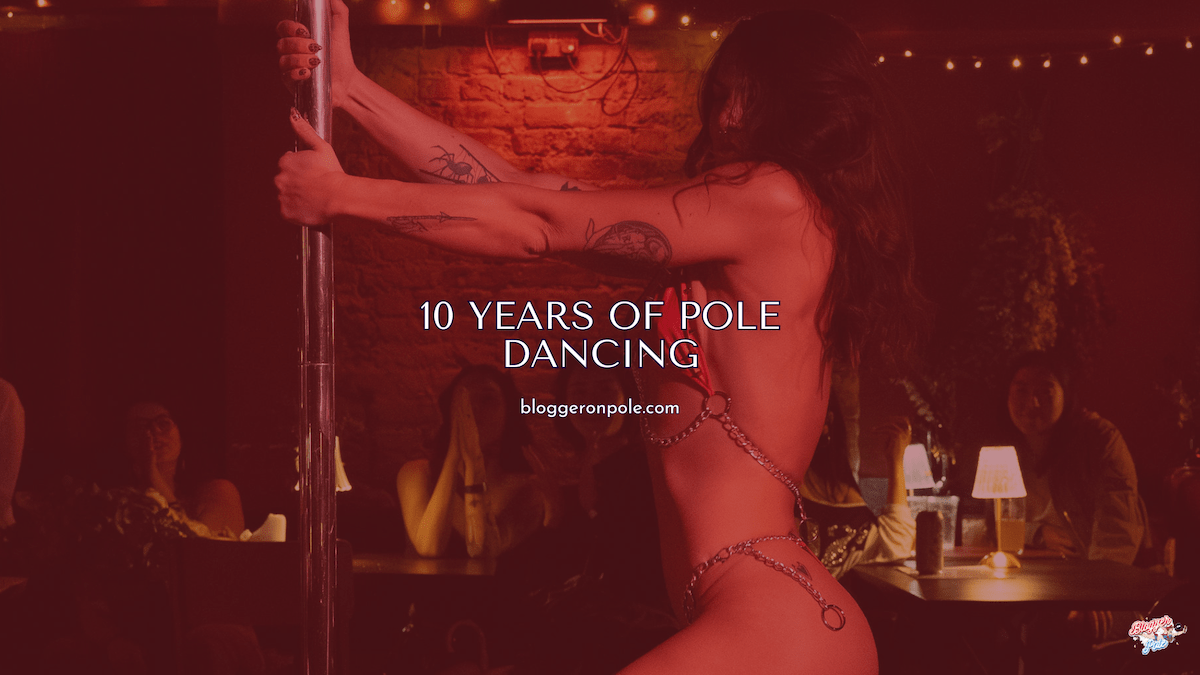
This year marks 10 years since I started pole dancing. I would have never thought that dancing around a metal stick would have changed my life this much, but here we are. However, in the formative decade that has seen me go from 23 to 33, my relationship with pole dance itself, and the industry around it, has changed, teaching me a lot about this art and about myself. Here’s how my relationship with pole dance has changed in the past 10 years, and why I believe it’s at its healthiest now.
Pole dancing changed my life 10 years ago, but it’s not my (whole) life
Around this time 10 years ago, I was attending my very first pole dance class after having uprooted myself to Australia, where I would retrain as an academic. I was recovering from an abusive relationship and sexual assault, feeling very lonely, lost, and angry with myself and my body. When I signed up for my first pole class, I was just trying to stay afloat and out of my head – instead, the whole trajectory of my life and my work changed.

My already popular blog and social media account became all about pole and its adjacent topics – sex work, sexual freedom and expression, education and pleasure. My digital criminology research became about censorship of sex, inspired by the activism of the sex workers that inspired me both in my dancing and in my advocacy (you can read more about it in my chapter for Bloomsbury’s Sex on Stage). It was thanks to all of this that I ended up publishing what I believe is the first research paper showing how shadowbanning manifests on a user’s profile, by reverse-engineering my experience of censorship on my pole dancing account.
I found confidence and community in pole, learning from the lived experience of other dancers and connected with others as we started a journey of questioning bias and stigma, rejecting shame, searching for nuance and play – all things you normally stop getting access to as an adult and that pole dance, as an art and a sport created by strippers, is in a unique position to provide.
For a huge part of the last 10 years, I tried to attend as many pole events and classes as possible, reacted to every scandal, took every opportunity (and regretted it multiple times), ventured into teaching. But while the thought process, questioning and liberation ignited by pole 10 years ago are still at the centre of every fibre of my being, and even though I train everyday and perform regularly, pole dance is no longer my only life.
This felt like an important shift, which perhaps came post-pandemic, as I took up my postdoc and started working full-time in academia. At the time, I realised I enjoyed working as an academic, I found I was burnt out by pole teaching, and it became clear I was craving the economic stability I didn’t have when ‘freelancing’ as a pole instructor. In short: I wanted to pole dance forever, but to do that I needed to nurture my passion physically and mentally towards longevity, and not turn my hobby into another full-time job.
At this stage, 10 years since my first class, pole dance is part of my past and present, and hopefully it will be part of my future. But to do so, it has to be more than my one and only personality. When my personality was all about pole, a feeling that hits a lot of people who first take it up, injury or a not-so-great performance would ruin my life, pole drama used to stress me out, and I was very online. I poured energy and money into events, spaces and people that didn’t always give back.
Although pole is central to my life and mindset, I have now diversified the spaces in which I find meaning. Pole dance is one of them: the adrenaline I get from being on stage or achieving a trick never end, and the friends you make along the way are unique. But I find that diversification more nurturing, because when pole is something you do instead of something you are, setbacks are just setbacks, and not ruin.
I used to perform for the industry, now I perform for the audience
As Adam Lin argued recently, and as I myself wrote many times, pole dance is one of the few practices where competitions can be unregulated, shambolic and confusing. In the 10 years since I have taken up pole, strides have been made to make competitions better, more inclusive, safer and to make judging clearer and more constructive. I have competed in many an event, and have witnessed both fantastic and horrific event-running.
But as I wrote more extensively elsewhere, now that I have built enough of a profile and that the industry has changed to accommodate for different events and needs, I have stopped seeking validation from the industry and I prefer to entertain outside audiences instead.
I realised the only thing that truly makes me happy as a performer is to hear the loud cheers of an audience, not experiencing the anxiety of being in front of a judging panel.

10 years ago I sought perfection – now I seek learning
The reason why pole dancing is so intoxicating is that it doesn’t really have an end point. It evolves, with new styles, tricks, influences and approaches changing it throughout the years. This means you never stop learning.
You are never ‘perfect’ as a pole dancer, because next year’s you will find little ways in which you could jazz up a perfect-looking routine from last year with the new techniques and flows you learnt. You never reached the finish line, because your skills, body and influences will change with time.

At first I wanted to make my hobby my job, but now I want my job to feel more like a hobby
To evolve with pole, I must nurture my passion and learn, something that, unsurprisingly, you don’t always have time for if you have a full-time job, a life, and then try to monetize your hobby by teaching and creating content.
In the past few years, I have realised I couldn’t follow the apparently natural “from hobby to job” trajectory that is a characteristic of our industry, and that Pam Briggs and I discussed in a recent research paper.
I really admire everyone who did this successfully, but turning something I took up for my wellbeing into a job – part or full-time, as it was during my PhD – killed my love for pole for a bit, because it was one of the many jobs I was doing to make ends meet, and instead I had no outlet to let go of stress.
We are told work doesn’t feel like work if it’s your passion. In reality, your passion isn’t as fun if it’s work. So I stopped teaching regularly and limit my performances to paid ones I know I’ll enjoy.

I used to eyeroll at the mention of cross-training, now I swear by it
Everyone who told me to cross-train – be it with weights, or through other sports – to improve my pole dancing a few years back would get an eyeroll from me. Now, I’m a pilates girlie and cross-training convert, and it shows.
Since the beauty of pole dancing is that it can be done by everyone, without previous athletic or dance experience, the truth is we come to it with little breathing or moving skills. We tend to prefer a side of our body over another, which is fully normal but unhelpful towards longevity and dancing, and we often push too hard to achieve tricks or prep performances.
As soon as the injuries started piling up, and as I grew older, I began finding pilates a godsend: it taught me how to breathe, helped me strengthen my other side to improve my strength and flexibility while balancing me out, and it’s made me a better and safer dancer and performer.
Throughout the past 10 years, the wish to improve as a pole dancer has meant also taking up stretching and contortion, not my forte but necessary to achieve moves such as the inverted eagle, one of my go-tos.

Ultimately, I wanna pole dance forever, so protecting myself through hard work trumps achieving a trick when I’m not ready for it.
I focus on hard work more than talent
There is a misconception, especially around beginners or those considering whether to take up pole dancing, that to do it you have to be a trained dancer, naturally talented, or flexible, or strong, or coordinated.
I’m not gonna lie, a lot of these things can make your life easier in pole. But they aren’t at all necessary, particularly at the start of your journey, because you build them when training.
If it was all about being strong or having previous dance experience, then body builders or ballerinas wouldn’t struggle when trying pole – and there is plenty of content on the internet that shows they very much do. So this brings me to one of the harshest pole realities: pole dancing takes work. It’s not effortless.
If it looks effortless, it’s because the pole dancer you are watching is incredibly skilled, and has built that effortlessness. Meaning that you will need hours, days, months and years to build it, and that there isn’t a formula to get good quick or look the part without effort.
You just have to struggle, which is why, as I said before, pole is never boring: there is always something new you could struggle with (or something old, if it’s a move you haven’t done in a while and have forgotten).
I regret rushing as a beginner
The most joyful moment in your pole career will probably be when you are a beginner, where everything feels shiny, new and exciting, and you aren’t comparing yourself to others as much.
I wanted to rush that moment, as do many beginners, to feel like I belonged, like I was a good pole dancer.
I was wrong.
Being a beginner is also the moment before the capitalist notion of the “side hustle” comes in: while ‘hustle’ is a sex work concept, it’s been co-opted by social media to mean any job, often done on top of a more traditional one, prompting us to professionalise and monetise literally everything. Yes, this could mean seeking meaning outside of the traditional nine-to-five, but also supplementing precarious employment with more work, or in general having to legitimise everything as a job rather than as a hobby.
As a beginner, I wasn’t putting metrics, success, achievements over something fun and artistic – something we must all do if we want to sell classes, keep studios afloat, make content. Which, incidentally, is also why I don’t want pole dancing to become an Olympic sport: I don’t want more metrics, more boxes to tick for people to think they must be athletes in order to join, or that there is a bigger milestone for them to meet.
Stay amateur for as long as you can.
It’s fun.

Social media have both made and broken pole dance
10 years ago, social media platforms were the space in which I connected with dancers worldwide, found inspiration, shared my journey. They felt overwhelmingly positive. Now, I am more ambivalent about them, and not just because I am a digital criminologist critiquing platforms in the age of technofascism, aka when companies sold out to the far-right and engage in so much surveillance and censorship that you can’t see your fave polers but are served a loop of hate and violence.
As I wrote many times, social media tutorials and, later, content have been crucial to the mainstreaming of pole, as well as to the earnings and growth of many dancers – yours truly included – and to educating about pole’s stripping origins.
Yet, aside from the censorship that plagues us daily, social media have also meant that a highlight reel of tricks and flows that took years to master look like they could be learnt in 10 minutes. This cheapens our art into something that can be consumed without payment and scrolled past, making beginners think they suck because they can’t do a spatchcock, tanking businesses who don’t make content or are censored, and helping platforms profit from drama and our presence while our wholesome posts are hidden.
It’s not like I have a solution to this, but until we ourselves learn what drives and thrives on these platforms, and until these platforms continue to act solely for profit, we will still be in this stalemate. It’s very important we don’t compare our lives and journeys to the highlight reel of another pole dancer.
I used to think pole dancing was revolutionary, but it can only be so if we fully embrace sex workers
Profit also drives how we act as an industry and as people, and it’s because they want to profit from an art that strippers made without being associated with them that many businesses and individuals still deny where pole comes from, and exclude its founders.
But whether we like it or not, pole is political.
If you profit from, or engage with, an art made and popularised by sex workers, the least you can do is credit them, hire them, treasure them, fight with and for them – or get off the pole.
The revolutionary impact of pole dancing on our lives and our own release from shame can never be fully realised without sex worker inclusion, for which we have to act as a bridge into the rest of society, now that pole dance is so mainstream.
Pole dancing is an industry, not a community
When entering the often supportive and uplifting environment of a pole studio, it’s easy to feel part of a community. Yet, the reality is that you are entering a pocket of a growing and developing industry. Within that microcosm exist real communities, as well as issues of image management, workers’ rights, and business interests.
This isn’t necessarily bad: businesses can change lives, and the success of pole dance as an industry shows that.
The issue is that, as many before me have argued (the PD Filthy Friday Zoom lives during the pandemic come to mind), viewing pole as a community and not an industry stops us from interrogating crucial matters of precarity, working practices, event safety, diversity and inclusion, and so on.
This doesn’t mean that communities can’t form inside of commercial spaces. It just means that a brand is not a community, and that community shouldn’t be used against you when you demand rights at events or in workplaces. We should instead take a page out of sex workers’ books, and unionise as performers and instructors for this stuff, and talk about community as a relationship, not as a weapon.
Why my relationship with pole feels healthier than ever 10 years on
10 years on, I am still obsessed with pole, but I have stopped being naive about it. I am trying to make this metal stick (and everything that comes with it) work for me, instead of the other way round. It’s neither a magic stick nor a stick to beat myself with.
It’s just a potentially revolutionary and incredibly fun practice to take up, if you do right by yourself, and by its history.
Pin this post